One quiet Saturday morning, my friend Emily was baking cupcakes with her six-year-old son, Noah. As they squeezed icing onto the cakes, Noah paused and asked, ‘Mom, why does the icing bag have a pointy end?’ Emily smiled and said, ‘That is called a cone. It helps guide the icing neatly onto the cake.’ Noah looked thoughtful, then pointed to his party hat from last weekend and said, ‘Is that a cone too?’ And just like that, a math moment was born—right in the middle of the kitchen.
At Uncle Math Lab, we believe that math begins in moments like these. Not in textbooks, but in kitchens, gardens, and playrooms. Our eBooks, designed for kids aged 6 to 8, use the 3H approach—Heart, Head and Hand—to help families explore math through stories, gentle thinking, and hands-on play. And cones are one of the most delightful shapes to discover.

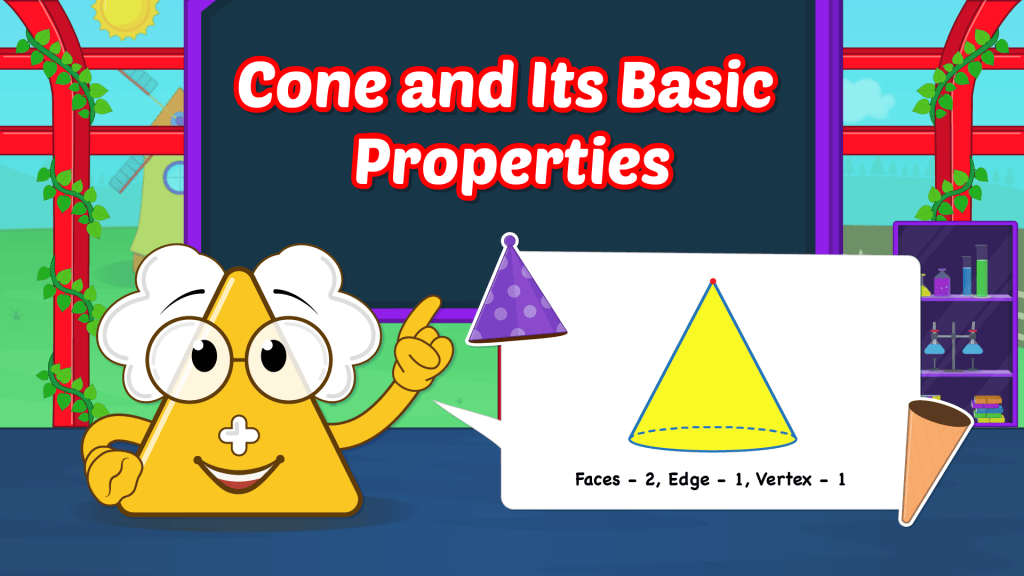
A cone is a 3D shape with one flat circular face and one curved surface that comes to a point at the top. That point is called the apex. Imagine a triangle spun around to make a solid shape—that is a cone.
Cones are everywhere. Ice cream cones, party hats, traffic cones, carrot tips, pencil points, funnels, cupcake icing bags, megaphones, wizard hats, and even the nose of a rocket. These are not just objects—they are invitations to explore.
When Noah and Emily started looking around the house, they found cones in the fruit bowl, the art drawer, and even the garden. ‘Mom, the flower pot looks like a cone if I turn it upside down!’ he said, proudly. Suddenly, math was not just on a worksheet—it was part of their day.

Kids remember what they feel. That is why our eBooks introduce cones through gentle, character-led stories.
One of our favourites is about a little inventor named Sam who wants to build a rocket. He tries different shapes for the nose, but only the cone cuts through the air smoothly. Sam learns that cones are not just pretty—they are practical.
Another story follows a girl named Lily who is helping her mumma bake cupcakes. She wonders why the icing bag has a cone-shaped tip. Through her questions, kids learn that cones help guide things—whether it is icing, air or even cars on the road.
These stories help kids connect emotionally with shapes, making learning feel like part of their everyday world.


Once the story sparks interest, we guide kids to think about what makes a cone a cone. How many faces does it have? Can it roll or slide? What happens when you stack cones?
Our worksheets invite kids to colour cone shapes, compare them with cylinders and spheres, and explore how cones behave. We ask questions like:
- What happens when you try to roll a cone?
- Can you balance a cone on its point?
- Which cone is taller—your party hat or your ice cream?
One dad, Mark, told us his son, Jake, started testing cones in the garden. ‘He rolled a funnel down the slide and said, “It spins!” I had never seen him so curious about shapes before.’
Another mumma, Laura, shared how her daughter, Grace, used her crayons to draw a wizard with a cone-shaped hat and a carrot wand. ‘She said cones are magical because they can be hats, horns and rockets. I loved that.’

This is where the fun begins. Kids learn best when they use their hands. In our Maker Activities, we invite them to build cones using paper, Play-Doh, or even fruit. They cut, fold, shape and explore. They feel the curves, test the balance, and see how cones behave.
Here are a few playful ideas to try at home:
- Make paper party hats and decorate them with stickers
- Use a carrot to explore cone shapes in nature
- Roll a cone down a slope and watch how it spins
- Fill a funnel with water and talk about how the shape helps guide the flow
- Stack ice cream cones and see how many you can balance
- Use modelling clay to make cone-shaped trees, mountains or noses for snowmen
- Turn a megaphone into a math moment—talk about how sound travels through the cone
One family turned their living room into a ‘cone museum’—with labelled objects from around the house. Another made cone-shaped rockets and launched them with straws. A mumma named Rachel told us her son, Ethan, made a cone-shaped crown for his teddy bear and called it a wizard’s hat. These moments are not just fun—they are powerful learning experiences that stay with kids long after the activity ends.
Here are a few simple facts to share with your kid:
- A cone has 1 flat face (a circle) and 1 curved surface
- It has 1 edge and 1 point (called the apex)
- It can roll, but not in a straight line—it spins
- It is found in many everyday objects like party hats, funnels, carrots, pencils, megaphones and ice cream cones

You can turn this into a scavenger hunt. Ask your kid to find five cones around the house or garden. Let them hold, roll and talk about what they notice. You may be surprised how quickly they begin to see the world through a mathematical lens.
Understanding shapes like cones is more than just geometry. It helps kids develop spatial awareness, curiosity and confidence in exploring the world around them. When they learn through stories, reasoning and hands-on play, they do not just understand math—they begin to enjoy it.
As a parent, you are not just helping with homework. You are shaping how your kid sees learning. Whether you are baking together, crafting a party hat, or chatting about the shape of a pencil, your presence makes all the difference.
At Uncle Math Lab, we are here to support that journey. Our eBooks are crafted to make math feel like a story worth telling, a puzzle worth solving, and a skill worth celebrating.
