
It was one of the regular afternoons post lunch, where a ten-year-old Olivia was curled up at the dining table, pencil in hand, staring at her math notebook.
‘Mumma,’ she said, not lifting her head, ‘I don’t get this HCF thing. Why do I have to break numbers into tiny pieces?’
Her mumma didn’t rush to answer. She sat down beside her and said, ‘Let’s not worry about the worksheet right now. Let’s just talk about the numbers. There’s a story in them, you know.’
That’s where learning begins. Not with pressure. Not with perfect answers. But with a pause. A moment. A shared breath.
This is what we believe in learning that starts with Heart, grows with Head, and stays with Hand. It’s the rhythm behind every page of our Uncle Math Lab’s ebook on HCF, written for families who want math to feel like something they can hold, not just solve.

Let’s start with something your kid already knows.
Imagine Olivia and her cousin Noah are playing with building blocks. Olivia has 24 blocks. Noah is 36. They want to build towers that are all the same height, using every block they have.
The question is : what’s the tallest tower they can both build without leaving any blocks behind?
That’s what HCF helps us find : the biggest number that fits perfectly into both 24 and 36. It’s about fairness. Sharing. Finding what works for everyone.
When Olivia heard that, she looked up. ‘So it’s like finding the biggest piece that works for both of us?’
Exactly. And prime factorisation is how we get there, gently, step by step.

Now that the story makes sense, we can walk through the method. No rush. Just side by side.
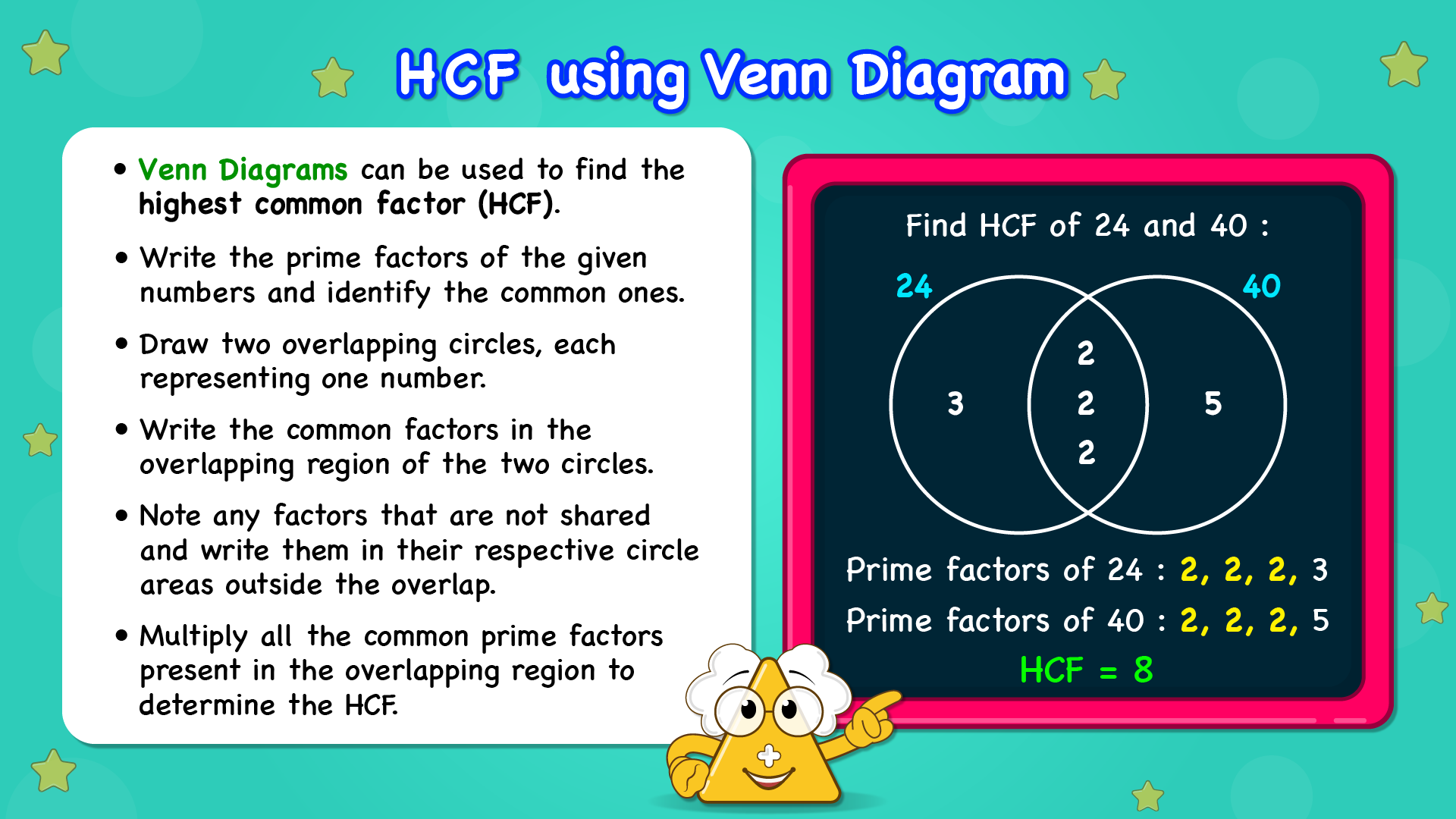
Prime factorisation means breaking a number down into its smallest building blocks that are the prime numbers that multiply together to make it.
Let’s take 24 and 36.
- 24 = 2 × 2 × 2 × 3
- 36 = 2 × 2 × 3 × 3
We look at the common prime factors they both have. In this case, they both have two 2s and one 3.
Multiply those together : 2 × 2 × 3 = 12
So, the HCF of 24 and 36 is 12.
You can say to your kid :
- Let’s break the numbers into their tiniest parts.’
- ‘The biggest shared piece is the HCF.’
At Uncle Math Lab, our ebook walks through examples like this with warmth and clarity. It’s written like a conversation, not a lecture. It helps kids aged 8 to 11 feel like they’re discovering, not just solving.


This is where understanding becomes real, when kids use their hands to explore.
HCF Hunt
Pick two numbers from around the house, such as the number of crayons, apples, or socks. Ask your kid to find their HCF using prime factorisation. Make it a mini challenge. Let them explain it back to you.
Every activity in our Uncle Math Lab ebook is designed to feel like play. It’s not about ticking boxes. It’s about noticing, building and sharing.

Our ebook on HCF is not just a resource. It’s a companion.
It begins with stories, grows with understanding, and stays with hands-on discovery. Powered by the 3H approach:
- Heart : Every concept begins with a moment that feels familiar
- Head : Gentle explanations guide understanding without pressure
- Hand : Activities invite kids to build, fold and explore
Whether you’re sitting at the dining table with your kid, folding clothes, this ebook is there to support you : quietly, kindly and with warmth.
So next time your kid asks, ‘Why do I need to break numbers into bits?, pause. There’s a story there. And a lovely little learning moment, waiting to be noticed.