
Last Friday, while packing for a weekend picnic, my son Liam asked, ‘Mumma, do you think it will rain tomorrow?’ I looked at the sky, checked the forecast, and said, ‘There’s a chance, but it’s not very likely.’ He paused, then asked, ‘So… what are the chances?’ That was our moment. A quiet, everyday question that opened the door to probability.
If you’ve ever said, ‘Maybe’, ‘Probably’, or ‘There’s a good chance’, you’ve already introduced your child to the idea of probability. You may not have called it that, but you’ve lived it. Probability is not just a math topic. It’s a way of thinking about uncertainty, possibility, and the little surprises life throws our way.
At our Uncle Math Lab, we believe in the 3H approach — Heart, Head, and Hand. That means every concept we teach is not only about understanding, but also about feeling connected and being able to use it in real life. Our latest ebook on foundational math brings this philosophy to life, and probability is one of those ideas that helps kids make sense of the world around them.
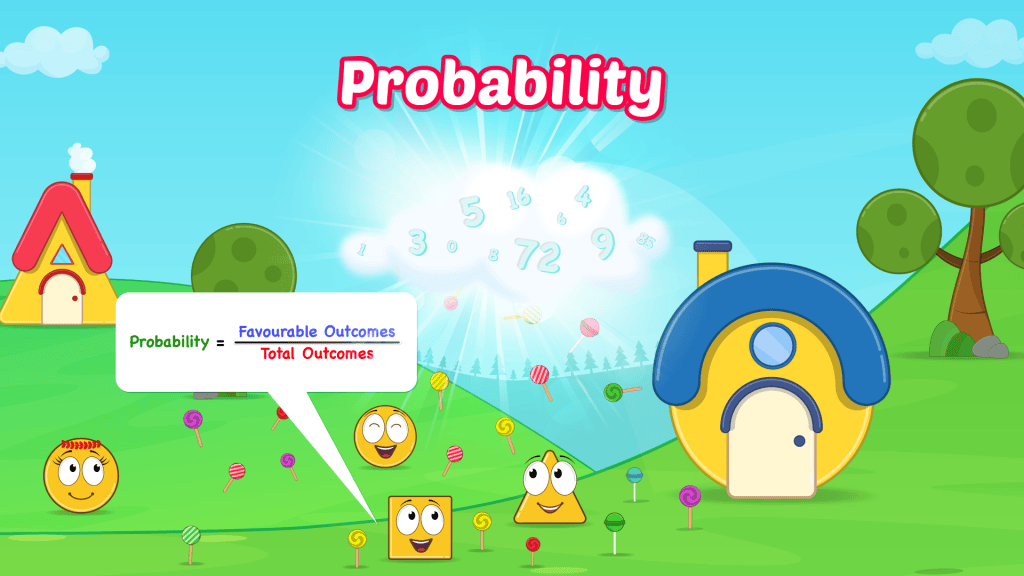
Probability is a way to describe how likely something is to happen.
It helps us answer questions like :
- Will it rain tomorrow?
- What are the chances of pulling a red sweet from the jar?
- Is it likely that my team will win the match?
We often use words like ‘certain’, ‘likely’, ‘unlikely’, and ‘impossible’. But we can also use numbers. Probability is measured on a scale from 0 to 1.
- 0 means something cannot happen.
- 1 means something will definitely happen.
- Anything in between shows how likely it is.
For example :
- The chance of flipping a coin and getting heads is one out of two.
- The chance of rolling a three on a dice is one out of six.
It’s gentle math. The kind that shows up in weather forecasts, board games, and even birthday party plans.
I remember my friend’s daughter Emma, who was playing with a jar of coloured beads. She asked, ‘If I close my eyes and pick one, will it be pink?’ They counted the beads together — three pink, seven blue, and five green. Emma said, ‘So it’s not very likely, but it could happen.’ That moment turned a guessing game into a math conversation.
And then there was little Ava, who was helping her mumma bake cookies. They had one tray with chocolate chip and one with plain. Ava asked, ‘If I close my eyes and pick one, will it be chocolate chip?’ Mumma smiled and said, ‘Let’s count and see.’ That small moment — warm, sweet, and full of curiosity — became a quiet celebration of logic and learning.
Even young Noah, who was playing a board game with his older sister, paused before rolling the dice and said, ‘I hope I get a six. That’s the only way I win.’ His sister replied, ‘Well, there’s one six and five other numbers, so it’s not very likely.’ They giggled, rolled, and learned — all in one go.
These stories remind us that probability is not just about numbers. It’s about noticing patterns, making predictions, and understanding that life is full of possibilities.
- Think clearly about chance and uncertainty
- Make informed guesses and predictions
- Understand fairness in games and everyday choices
And for parents, it opens up gentle conversations about decision-making, risk, and planning. Whether it’s choosing clothes for the weather, playing board games, or deciding when to leave for school, probability becomes part of everyday learning.
Our ebook, designed for kids aged 8 to 11, does not just explain probability. It helps them feel it. Through warm stories, hands-on activities, and relatable characters, kids explore real-life situations where chance and choice come together.
- Heart : Every story is rooted in family life and emotional connection. From rainy days to game nights.
- Head : Concepts are explained clearly, with age-appropriate language and gentle scaffolding.
- Hand : Kids apply what they learn through games, challenges, and everyday examples. Like predicting outcomes or designing their own lucky draw.
Probability is not just about predicting the future. It’s about thinking calmly, making sense of uncertainty, and learning that not everything is fixed and that’s perfectly fine.
So next time your child asks, ‘Will it happen?’, you might just sit beside them, talk it through, and say, ‘Let’s think about the chances together.’
And if you’d like to explore more story-rich, heart-led ways to teach math, our ebook is ready. It’s filled with warmth, wisdom, and a whole lot of heart. Would you like me to share a simple home activity next? Something mumma and child can try together using coins, dice, or even coloured buttons. A lovely way to bring probability to life, right in your living room.