
Some of the most meaningful learning moments happen quietly. No worksheets. No formal teaching. Just a child noticing something in the middle of their day.
One morning, while arranging building blocks, my daughter turned a circular piece and said, “It still looks the same.” That was rotational symmetry, discovered rather than taught. For children aged 3 to 6, symmetry is not only a mathematical idea. It is a feeling of balance, a gentle joy when things line up just right. For us parents, it is a chance to pause and see the world through their eyes.
With the 3H approach of Heart, Head and Hand, rotational symmetry becomes more than a concept. It becomes something we notice, understand and create together.
 HEART : A Story of Noticing
Before children learn the word “symmetry”, they sense it. I remember my nephew spinning a paper plate he had decorated. He stopped, looked closely, and said, “It still looks the same when I turn it.” That small moment held more mathematics than any flashcard.
Rotational symmetry lives in these everyday rituals: in wheels that keep turning, in flowers with petals arranged around a centre, in the way children spin their toys and smile when they look unchanged. Learning begins with noticing, with feeling, and with the quiet joy of seeing something come together.
 HAND : A Hands-on Activity to Bring It to Life
Learning deepens when children use their hands. Here is an activity that brings rotational symmetry into the real world:
Spin and Match
What you need :
- paper plates
- coloured pens
- scissors
What to do :
Ask your child to draw a simple design on the plate, such as a flower or star. Cut out the plate and place a pin or pencil through the centre so it can spin. Turn it slowly and ask, “Does it look the same now?” Let them notice, let them lead.
This is not just craft. It is mathematics in motion. It is the symmetry that they can touch.
 HEAD : Making Sense of What They Already See
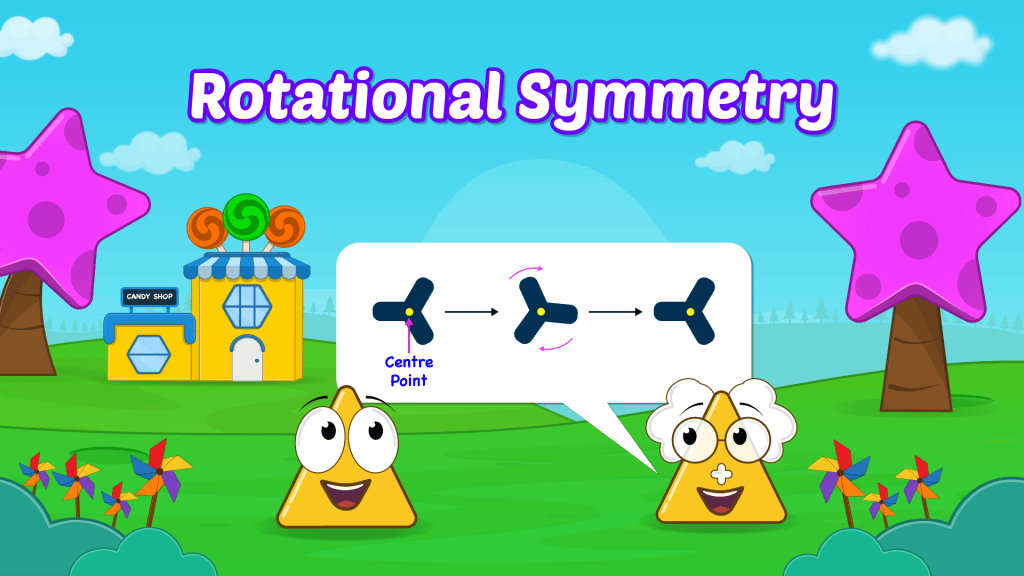
Rotational symmetry means that a shape looks the same after being turned around a central point. Circles, triangles, and many patterns in nature show this property. It is not only in geometry. It is in design, in art, in the way we decorate and build.
My son once turned symmetry into a game. He would spin shapes and challenge me to say how many times they looked the same in one full turn. His excitement was not about being correct. It was about seeing something beautiful.
Understanding rotational symmetry helps children think clearly, compare thoughtfully, and see connections. It is not about memorising. It is about making sense.
Our eBook at Uncle Math Lab includes gentle, easy-to-understand worksheets like these. They are designed for kids aged eight to eleven, with simple language, relatable examples, and a warm, parent-friendly tone. There’s no rush. Just a quiet discovery.
A Closing Thought
Rotational symmetry is not only something we explain. It is something our children discover, in spinning wheels, in turning plates, in the way they arrange their world with care. And when we explore it with heart, head, and hand, we are not only teaching a topic. We are building a connection. We are helping our children feel at home in their learning.
If you are looking for a resource that brings this kind of learning to life with gentle stories, hands‑on activities and worksheets, our ebook from Uncle Math Lab is ready for you. It is designed for families who want mathematics to feel familiar, joyful and full of meaning.
Let this be the start of something lovely.