
“Look, I have more grapes than my sister!”
If you have heard something like this before, your kid has already started developing one of the most important early math skills: comparing quantities.
Learning the concept of more and less is one of the first steps kids take toward understanding numbers, measurement, and basic arithmetic. At this age, kids do not learn through worksheets. They learn through everyday experiences, guided conversations, and meaningful play.
That is exactly why we created our math comic books using the 3H Approach : Heart ❤️, Hand ✋ and Head 🧠. It is a way of teaching that makes math personal, playful, and powerful. Let us take a closer look at how you can introduce the idea of more or less to your kid in a way that truly sticks.
In simple terms, number comparison is when kids look at two groups of things and decide:
Which group has more
Which group has less
This helps build number sense, an intuitive understanding of quantity and value. Kids begin to realise that five is more than three, that seven cookies cannot be shared evenly between four kids, or that their cup is less full than their sibling’s.
It is a foundational skill that leads to confidence in :
- Counting and estimating
- Understanding greater than and less than symbols later
- Mental math and problem-solving
And it all begins with comparing apples and bananas, buttons and crayons, or any everyday objects right in front of them.


Young kids make sense of the world through stories. That is why our comic book adventures begin by placing kids in relatable, playful situations.
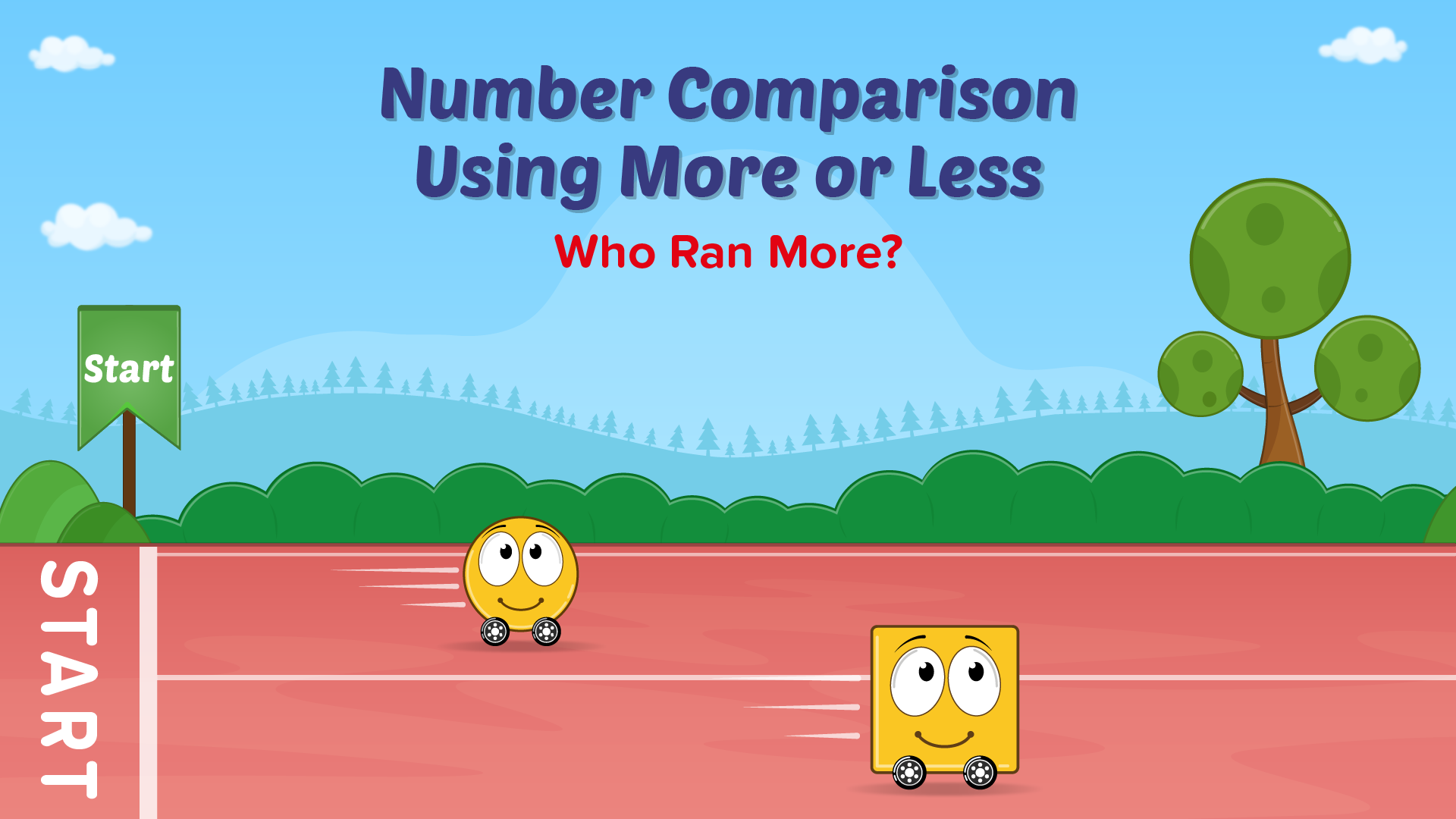
In our story, kids from Samper town run on a track and have a small fight to decide who ran more. The story is about solving their fight skillfully using a math trick.
These gentle, funny moments help kids connect emotionally to the idea of comparing groups. They see themselves in the characters, and with that connection, they begin to care about solving the problem.
Try this at home :
Make it a story. “Oh no! Teddy has only two building blocks, but Bunny has five. That is not fair! Can we help Teddy get more?”

Once the story sets the stage, it is time to gently guide your kid into thinking about how comparison works.
In our math comics, we use simple illustrations such as two bowls of fruit or two piles of coins to help kids see the difference between amounts. They count, compare, and begin using math language like:
“This is more.”
“That is less.”
“Both have the same.”
By repeatedly seeing and discussing these ideas, kids build logical thinking without pressure. They begin to internalise patterns and understand quantity as something real and meaningful.
Try this at home:
Line up toy cars in two rows and ask, “Which row has more? How do you know?” Encourage your kid to count and explain in their own words.

Nothing sticks like hands-on experience. Kids learn best when they are touching, sorting, and playing with real objects.
That is why each chapter in our comic book series is paired with play-based activities that allow kids to:
Compare two plates of snacks
Count toy animals and see which group is larger
Match pairs and see which side is missing more or fewer
These experiences turn abstract ideas into something they can see and feel, and that makes all the difference.

Try this at home:
Give your kid a handful of buttons and yourself a few more. Ask, “Who has more? Can you give me enough to make it equal?”
When a kid learns how to compare numbers, they are not just learning math facts. They are learning how to think. They begin noticing patterns, solving problems, and explaining their reasoning. These are skills they will use again and again.
Through the 3H approach, this learning becomes a natural part of their day, not something to be memorised or feared. It becomes a joyful habit of mind.
Our math comic book series is designed to work with how kids naturally learn. Each chapter blends :
- Engaging stories and real-life situations (❤️ Heart)
- Clear visuals and simple, kid-friendly logic (🧠 Head)
- Interactive, hands-on activities that make learning stick (✋ Hand)
It is not only about comparing numbers. It is about helping your kid build a strong, lasting relationship with math.
If your kid is between three and six years old, now is the perfect time to introduce number comparison in a way that feels playful and personal.
With the right tools, stories, language, and hands-on fun, your kid will soon be confidently saying, “This is more!” and “That is less!” with pride.
Explore our math comic book series today and give your kid a strong start in math, rooted in connection, understanding, and joy.